
Sexuele Voorlichting Puberty Sexual Education For Boys And Girls 1991 Englishavigolkesl Work __hot__
Installing the Remote Print Driver and registering a printer - Windows
 |
Download Remote Print Driver from the following URL: https://support.epson.net/rpdriver/win/
|
 |
Double-click “Setup.exe” of Remote Print Driver.
|
 |
Select EPSON Remote Print, and then click OK.
|
 |
Read the license agreement, select Agree, and then click OK.
|
 |
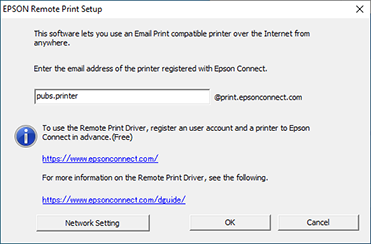
Enter the printer’s email address.
|
 Note:
Note:|
You can check the printer’s email address using one of the following methods.
From the information sheet printed when you completed the Epson Connect setup.
From the notification email sent when you completed the Epson Connect setup.
From the printer's network status sheet.
From the network status on the printer's control panel.
From the printer list on the Epson Connect User Page.
If you are not the owner of the printer and you do not know the printer’s email address, contact the owner of the printer.
|
 |
Click OK.
|
Note:|
If an access key has been set, the access key entry screen is displayed. Enter the key, and then click OK.
If you do not know the access key, contact the owner of the printer.
|

Installing the Remote Print Driver and registering a printer - Mac OS X
|
Download Remote Print Driver from the following URL: https://support.epson.net/rpdriver/mac/
|
|
Select Applications > Epson Software, and then double-click Epson Remote Print Utility.
|
|
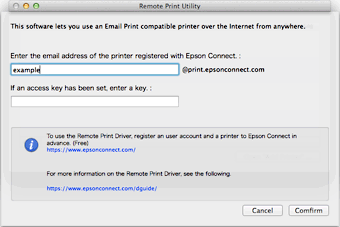
Enter the printer's email address.
|
Note:Sexuele Voorlichting Puberty Sexual Education For Boys And Girls 1991 Englishavigolkesl Work __hot__
Ends with adult intercourse and a scene depicting childbirth.
In the modern context, Sexuele voorlichting is a historical artifact—a snapshot of a particular moment in educational theory. It shows a world where a filmmaker, with limited resources and a cast of amateurs, could create a document so raw and direct. For many who grew up in Europe in the 1990s and early 2000s, a grainy copy of this film or its clips, often found on file-sharing networks or websites like RareFilm, was their first, shocking, and formative encounter with the mechanics of sex. Despite—or perhaps because of—its flaws, it succeeded in its primary goal: to inform.
Despite its dated aesthetic, the film’s core philosophy remains relevant. It succeeds where many modern programs fail by destigmatizing normal bodily functions. By explicitly addressing both boys and girls in the same educational space, it fostered a sense of shared understanding, breaking down the mystery and shame often associated with the opposite sex’s development. The 1991 production emphasizes communication and responsibility, values that are timeless even if the hairstyles are not. Ends with adult intercourse and a scene depicting childbirth
Unlike many mid-century American or British health films that relied heavily on abstract line drawings, metaphors, or clinical cross-sections, this Belgian production chose to utilize a mix of live models, real-world demonstrations, and watercolor diagrams to convey its curriculum. Core Curriculum and Topics Covered
Sexuele Voorlichting (1991), better known as Puberty: Sexual Education for Boys and Girls , is more than just a film. It is a statement. By rejecting sanitized diagrams and embracing explicit, real-world imagery, the documentary attempted to answer the most awkward questions of adolescence with clinical honesty. While it remains controversial, its thorough coverage of male and female anatomy, puberty, masturbation, and safe sex ensures its lasting relevance. For those who grew up watching it, it remains the definitive benchmark by which all other sex education media is measured. For many who grew up in Europe in
In the early 1990s, the approach to sexual education began to shift from a primarily abstinence-based model to a more comprehensive framework. This new approach acknowledged the complexities of adolescent development and the need for accurate, age-appropriate information about human sexuality, relationships, and reproductive health.
Anatomical education regarding the female reproductive system. The psychological impacts of estrogen fluctuations. It succeeds where many modern programs fail by
Awareness of methods available at the time to prevent pregnancy.
|
Click Confirm.
|
|
Click Open "Add Printer" ... and then add the registered printer.
|
Note:|
If you are using an authenticated proxy environment, the following screen may be displayed when printing.
In this situation, enter your computer login password, and then click [Always Allow] or [Allow].
 |